
What Do Sustainability Professionals Get Wrong About Utility-Issued “Renewable” Certificates?
Not all renewable energy “certificates” carry the same evidential weight.
A utility -issued green tariff confirmation tells you, in plain language, that your energy was renewable. But, it’s one degree of separation away from the document that’s considered to be the primary source of truth by the people who it matters for: auditors.
By simplifying for customers, utility confirmation slips typically omit the certificate serial numbers, the production plants, the vintage, and who legally holds the energy attribute. Most corporate teams underestimate that distinction, whilst auditors are trained to find it. Auditors know that utility-issue certificates are an abstraction, and they’re expected to investigate the source material that claims are derived from.
What data is missing from a utility-issued renewable energy certificate?
A utility-issued certificate is a self-produced document, not a regulator-issued one. The utility holds the registry account, cancels the Energy Attribute Certificate on your behalf, and sends you a summary. But, instead of receiving the cancellation certificates yourself, the utility provides a summary without the serial-level trail. This not the same as holding the proof. There's no transaction ID, no certificate serial range, no direct link to the national GO registry, and no confirmation that those specific attributes weren't allocated somewhere else. Buying these certificates in “proxy” from a utility also means accepting their asset mix. Old, subsidised Energy Attribute Certificates (EACs) with no additionality argument get bundled into green tariff products and presented as equivalent to purpose-built EAC procurement. It isn't, and you weren’t presented with the option to procure the exact certificates you truly needed or wanted.
The frameworks governing Scope 2 reporting - GHG Protocol , RE100 , and emerging CSRD requirements - demand attribute-level metadata: production technology, geographic origin, and vintage . A basket of undifferentiated, non-local, decades-old hydro certificates that get cancelled quietly behind a supplier's account won't satisfy any of that with precision. Certificate quality isn’t the only opaque aspect of this approach, but also pricing: it’s not uncommon for utilities to include cheap certificates in renewable packages, because they don’t expect anybody to look at the mechanisms beneath the surface. The mark-up applied on this opaque administrative loop is another topic altogether.
Utilities also aren’t typically at the forefront of corporate sustainability best-practices like granularity . Corporate procurement philosophies are moving toward granular matching to support 24/7 Carbon-Free Energy frameworks, and unless your utility contract explicitly mentions certificate qualities, it’s highly unlikely you’re able to “opt-in” for enhanced credibility or granularity. Even if this is promised, demand to see the certificates underlying the claims.
Why do auditors require registry cancellation statements, not supplier letters?
ISO-aligned GHG auditing , by default, traces claims back to primary evidence. A sustainability auditor looking into your Scope 2 figures will ask for the cancellation statement. A utility letter, produced by a commercially related party, is exactly the kind of corroboration gap that triggers further testing. Registry cancellation statements are the objective solution to this issue: they get issued by a national body, are timestamped, serialised, can have a written purpose associated with their cancellation and are tied to a named beneficiary - that’s you. An auditor can verify that chain directly.
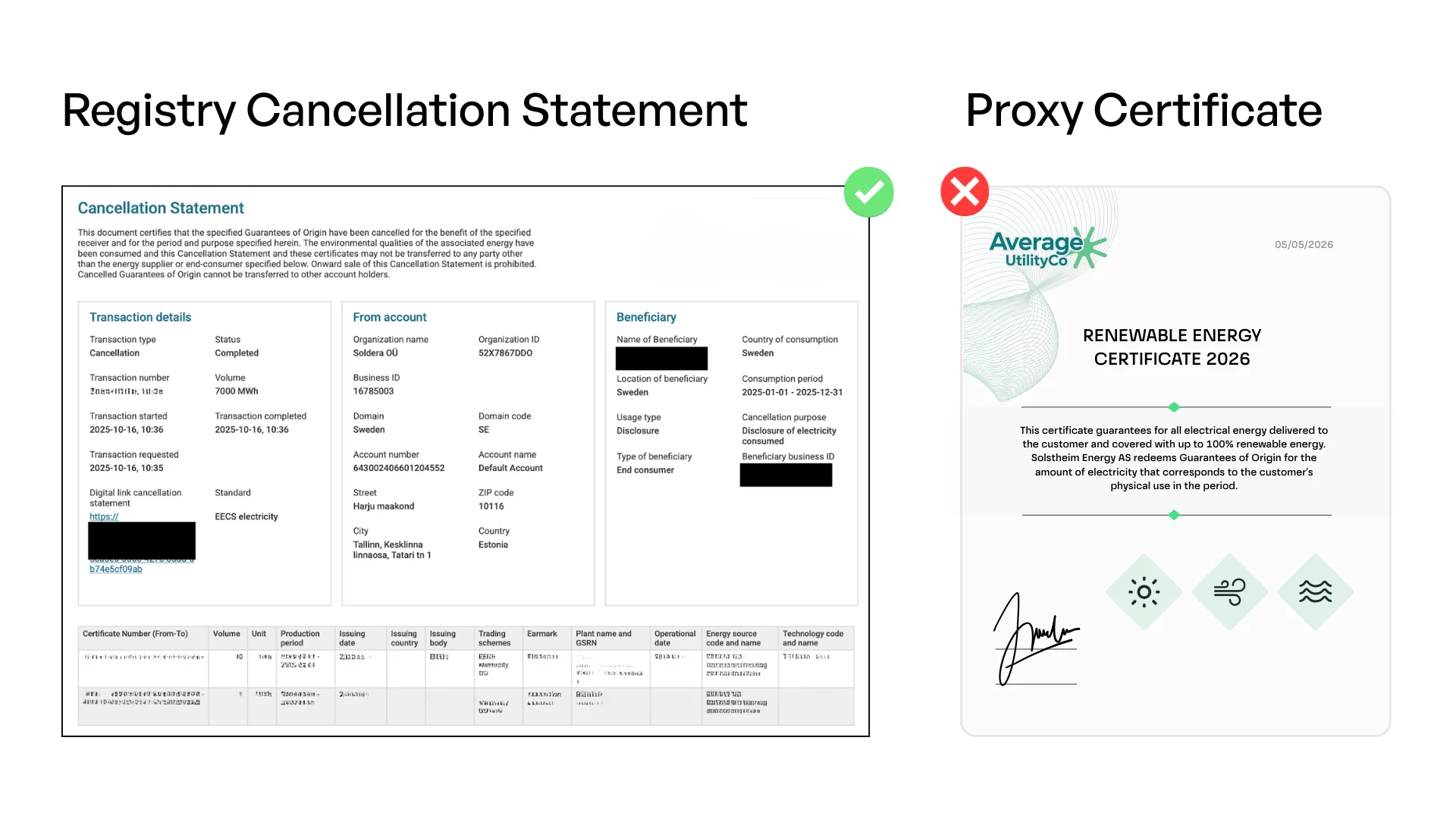
Leaving auditors dependent on intermediaries increases exposure to human error. Misallocations, miscommunications, vintage mismatches, and volume discrepancies are that much more likely to persist in supplier-managed accounts. This is because each private utility is individually responsible for connecting each certificate to its rightful claimant in their internal records - there’s no standardised third-party mechanism to get your name on the registry record. It’s imperative to remove that ambiguity to ensure your organisation is on the government registry records itself as the legal title holder of the environmental attribute.
Do I need a registry account to get these certificates myself?
Whilst utility companies offer “ proxy ” certificates, other service providers allow you to export the real thing, turning renewable procurement into something auditable and highly customisable as per your procurement approach. Platforms like Soldera know that you require access to the underlying record. Our platform gives corporate buyers direct accounts across 30+ European registries, with the ability to generate cancellation statements naming your organisation as the beneficiary. You’re free to procure in any jurisdiction, export-ready documentation, and source from our network of thousands of verified renewable energy producers. Exclusive accounting is what closes the gap between a questionable commitment and a credible one.
You're halfway there...
Sign up free to keep reading immediately and get Soldera's EAC market research, price updates, quarterly outlooks and renewable compliance insights direct to your inbox.



Schedule a 20-minute demo to find out if Soldera is right for you.