
What Is the Residual Mix?
Electricity grids carry a blended generation profile of the technologies supplying the grid: coal, gas, nuclear, wind, solar, with electrons travelling through the same wires irrespective of source.
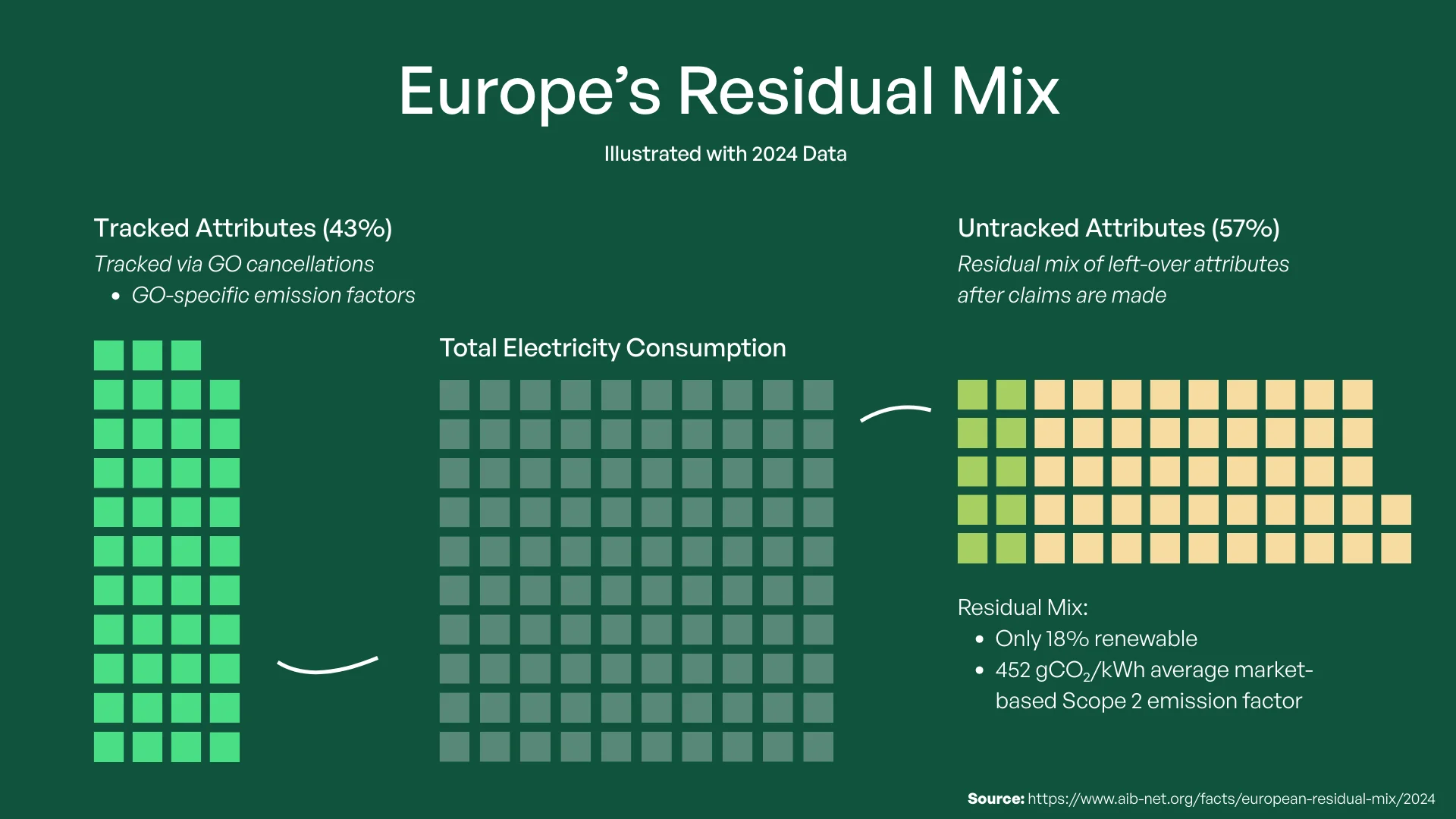
Contractual market-based instruments are therefore used to track energy attributes. When a company procures and cancels renewable energy backed by certificates, those certificates remove their corresponding share of verified renewable generation from the common pool, a mechanism known as book and claim. What remains after all claims are made is known as the residual mix - this is the emission factor describing the grid after tracked claims have been stripped out. It's not a penalty, but late-movers are essentially dealing with “leftovers” after all valid attributes have been subtracted by those that bought them. The onus is on reporting firms to act before the residual mix is their only reporting option.
Why is the residual mix higher than my country's grid average?
The residual mix is higher because it represents untracked or unclaimed electricity that cannot be considered renewable under market-based methods. This is why it’s an integral part of avoiding double counting at scale within market-based Scope 2 emissions frameworks - nobody can ignore it and it forces the hand of corporates to procure EACs or face the residual-mix consequences when it’s time to report.
Take the European Residual Mix, for example, which is published annually by the AIB. The AIB operates the AIB Hub, and has a complete view of every single issuance, transfer, and cancellation of Guarantees of Origin (GOs) . Because these GOs are what are “backing” individual claims to megawatt-hours of renewable electricity, when they are cancelled (used), they exit circulation, take their low emissions intensity with them, and their removal raises the average emissions intensity of all of the energy that hasn’t been matched with GOs. To recap: Every megawatt-hour tracked by a retired Guarantee of Origin is removed from the shared pool before the residual is calculated. Similarly, if an EAC expires, the specific generation attributes it represented are return to (or remain part of) the residual mix.
That’s why it’s expected that the residual mix carries a higher carbon intensity than national location-based grid averages - the latter of which have not had low-carbon attributes subtracted by design. As EAC markets mature in demand and uptake, that gap widens, because more verified generation is claimed by certificate holders rather than returned to the commons as "residual". The same logic applies across regions; the UK publishes equivalent figures through DESNZ (based on REGO activity figures) and North America through Green-e (based on REC activity figures).
How does the residual mix affect Scope 2 reporting?
For corporate buyers under GHG Protocol Scope 2 Guidance, this matters directly. Dual reporting is mandatory, and the market-based (MB) method requires qualifying EAC cancellations if the reporting company wishes to use emission factors that are lower than those of the residual mix. Without qualifying EACs, the residual mix is the mandatory fallback. Companies that choose not to procure certificates don't avoid the accounting burden altogether, quite the opposite - they simply inherit what everyone else effectively declined to claim by not procuring EACs.
How can I avoid residual mix exposure?
Treating EAC procurement as defensive accounting rather than purely aspirational is the mentality switch that corporates can benefit from before reporting season arrives. The question isn't really whether or not an organisation wants to be renewable, it's whether their documentation is in order before deadlines arrive.
Thankfully, Soldera connects corporate buyers to over 30 EAC registries with verified certificate procurement and export-ready cancellation statements - the exact instruments that displace residual mix attribution under market-based reporting . Buyers can simply upload their consumption data and requirements, get matched to appropriate EACs from 4,000+ producers with live pricing, then export verified documentation proving their renewable consumption.
You're halfway there...
Sign up free to keep reading immediately and get Soldera's EAC market research, price updates, quarterly outlooks and renewable compliance insights direct to your inbox.



Schedule a 20-minute demo to find out if Soldera is right for you.