Can Energy Attribute Certificates (EACs) Reduce Scope 3 Emissions?
The vast majority of companies pursuing net zero targets find out that one of just the three scopes poses the most difficulty: Scope 3. It's clear why: Scope 3 sits outside direct operational control. But since it is so conceptually broad, encapsulating the GHG emissions of all upstream and downstream firms in your value chain, it commonly represents the majority of a company's total footprint. Yet a substantial share of that footprint traces back to a single, tractable variable: electricity consumption in the supply chain. This is precisely where Energy Attribute Certificates (EACs) enter the picture, not as a workaround, but as an underutilised standards-aligned mechanism for supply chain decarbonisation.
Scope 3 isn’t truly out of your control: all you have to do is open a dialogue with your suppliers about their energy usage.
Where should I look for EAC opportunities in my supply chain?
Firstly, let's understand upstream and downstream: upstream covers everything before your company does anything (think suppliers, raw materials), whilst downstream covers everything after your service is completed or the product or actually leaves your hands. See the diagram below for the full GHG Protocol Scope 3 categories.
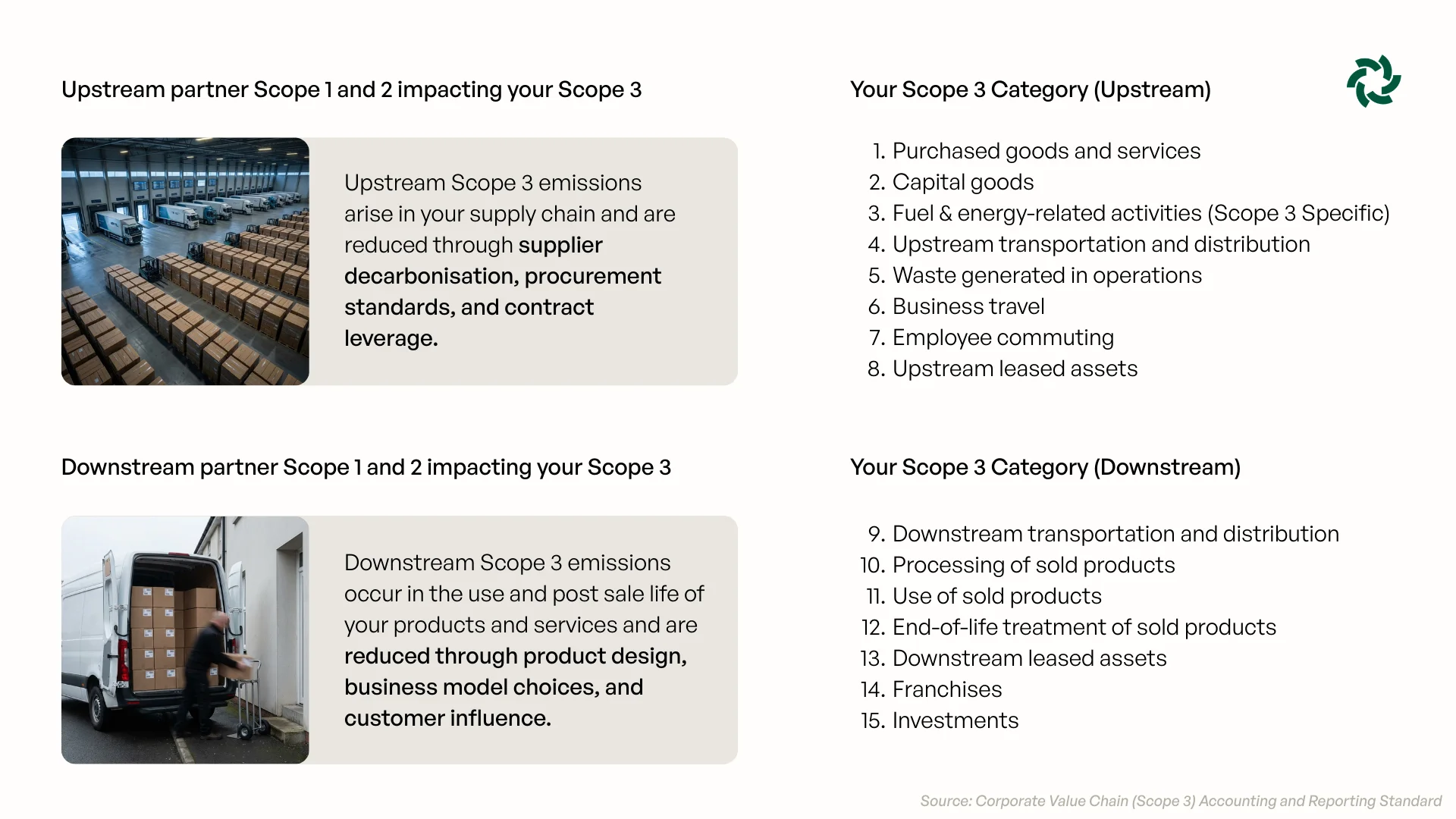
Look upstream for the lowest hanging fruit:
If your upstream or downstream value chain counterparties are located in any of the Categories in Image 1 and have Scope 2 emissions, EACs can be utilised to indirectly reduce your Scope 3. That being said, when sustainability teams map their value chain emissions, more often than not it’s Scope 3 Category 1 (purchased goods and services) that dominates. This is the category with an outsized proportion of emissions due to the electricity that suppliers are consuming during manufacturing and production. Given that electricity is measurable and markets for EACs are mature, this slice of Scope 3 is more actionable than most, and is a great place to start. EACs, including Guarantees of Origin (GOs) in Europe and RECs elsewhere, give buyers a standardised way to claim the environmental attributes of specific renewable generation. Each certificate, via a book and claim system, entitles the holder to claim one MWh of verified clean electricity via cancellation. When a supplier cancels GHG-protocol eligible EACs against their consumption, the matched MWh can use a zero emission factor in Scope 2 (market-based).
This reduces their own Scope 2 (market-based), and, if you’re using supplier-specific Scope 2 data, that reduction reflects in your Scope 3 - but there are two ways this can work. If the supplier cancels EACs without naming you specifically, then the MB benefit is effectively shared via whatever allocation method was reported. However, If they name you when reporting, the certificates can act as documented allocation showing the EAC-backed electricity is attributed to your share, strengthening the audit trail for exclusive allocation. When paired with a valid allocation method, these cancellations form a strong evidence pack to support other customers not claiming the same clean electricity as you. Attribution is the mechanism that controls whether the claim is shared or exclusive.
Note that field ‘beneficiary’ that appears on cancellation certificates is not the same function as naming an entity for attribution. The impact of the EAC itself always applies to the supplier's Scope 2 - they’re the beneficiary. It never touches yours - you just have named attribution.
Can I Simply Buy EACs for My Suppliers?
Yes, but this is best done only with their consent. You cannot unilaterally purchase and retire EACs on a supplier's behalf, because they need to apply it to their Scope 2. With their involvement, however, this is very commonplace. For instance, Apple funds renewable energy procurement for suppliers, and Walmart is running a similar model through Project Gigaton. The GHG Protocol does not restrict who pays for the EACs, only that the retirement is made in the supplier's name against their Scope 2, with attribution to you in the cancellation purpose field. The funding arrangement is purely commercial - and we’ve found that suppliers are usually very receptive so long as the outreach is coordinated, seamless, and professional. Soldera’s app meets the mark with our approach: Scope 3 “invitations”, with Soldera acting as the collaborative EAC procurement engine that slots into your framework of choice, such as the Center for Resource Solution ’s methodology for designing supplier EAC programmes.
Units-Based or Spend-Based: How Do You Size Your Supplier's Share?
But, before a brand owner can set targets or purchase volumes on behalf of suppliers, they should work out what a defensible figure for what share of a supplier's electricity consumption sits in their Scope 3. Two methods are widely used.
- The units-based method allocates electricity proportionally to production: a company purchasing 10% of a factory's output is responsible for 10% of that factory's electricity footprint.
- The spend-based method follows revenue flows instead: the percentage of a supplier's total revenue attributable to a given buyer determines the electricity share allocated to that buyer's Scope 3.
Why is Named Attribution Necessary?
We'll cover three primary reasons for named attribution.
- Exclusive claims when suppliers only partially cover their consumption with cancelled EACs
- Audit trail quality
- Downstream user-attributed emissions (Category 11).
Let’s unpack them.
1. Exclusive claims when suppliers only partially cover their consumption with cancelled EACs
This is the most common scenario, and one that Soldera is built to handle automatically. Remember: When using a “units-based” approach, a customer's share of a supplier's electricity consumption is also their share of the associated Scope 3 emissions. Therefore, it forms the fair basis for how many EACs they should fund. Let’s look at a fictitious real-world analogy:
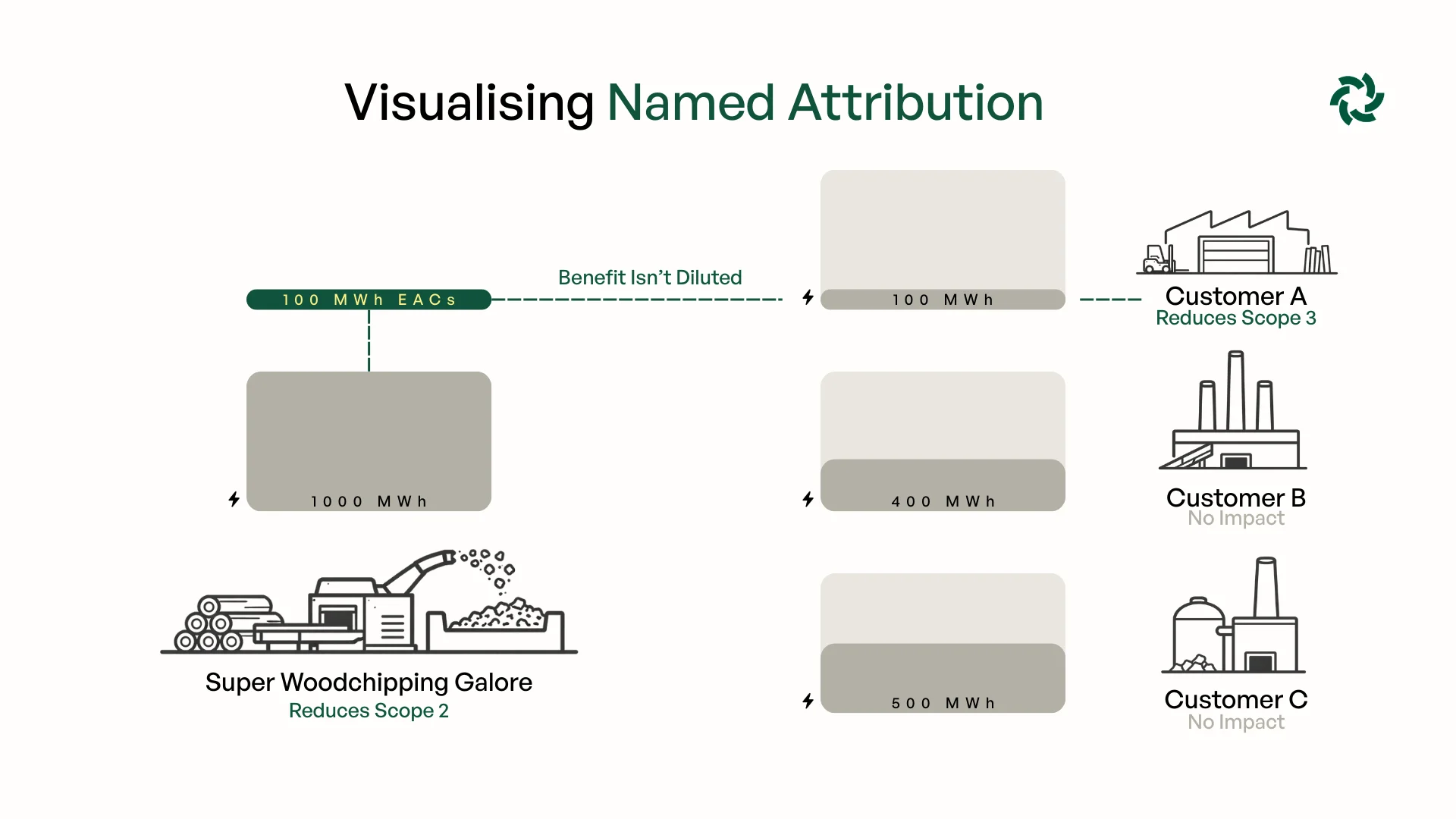
Imagine that a local supplier for woodchips, ‘Super Woodchipping Galore (SWG)’, has three bulk customers, who each buy woodchips in bulk at the same price point. There is no insight gained from conducting a “spend-based” emissions analysis here, because SWG has an energy intensity per customer that is unchanged by order size. (Note that “Spend-Based” approaches can be valuable tools for energetically-disproportionate order-books).
Electric woodchippers are very energy intensive, so one of SWG’s customers, Customer A, reaches out about utilising EACs, because they’re planning to reduce their Scope 3 emissions. However, Customer A only represents 10% of SWG’s electricity consumption, whilst Customer B represents 40%, and Customer C represents 50%. SWG agrees, but is not interested in matching 100% of their consumption with EACs. Customer A agrees to cancel EACs covering 10% of SWG’s total consumption.
Let’s recap the results:
- Without named attribution, all three customers receive a proportional share of that 10% benefit, regardless of who pushed for it or who helped fund it. Customer A, who negotiated the arrangement and subsidised the purchase would be heavily disincentivised in this scenario.
- With named attribution, Super Woodchipping Galore names Customer A in the cancellation purpose field. The full 10% benefit is allocated exclusively to Customer A. Customers B and C receive nothing from those EACs, and their Scope 3 is unchanged.
2. Audit trail quality
However, even if a supplier willingly covers 100% of their electricity consumption with EACs, named attribution still has a role to play. That’s because without it, a company that ends up claiming the benefit in their Scope 3 inventory must rely on a proportional calculation methodology to justify the claim. With it, there is a cancellation statement that explicitly names them as the beneficiary, serving as a direct link between the retirement and their Scope 3 inventory. It's simply the cleanest, most auditable method and isn't error-prone when multiple customers are simultaneously engaging the same supplier with no visibility over each other's claims. For companies under CSRD, CDP or (newly emerging) SBTi scrutiny, that difference in verification quality is significant, and demonstrates a proactive approach.
3. Downstream use-phase emissions (Category 11)
As briefly mentioned, EAC usage in Scope 3 are not only an upstream mechanism, despite upstream being the “lowest hanging fruit”. For instance: a manufacturer whose sold products consume electricity during use: IoT appliances, vehicles, industrial equipment, can choose to retire EACs with the goal to account for Category 11 emissions, which requires buying EACs in the market where the product is used and conveying the attribute-claim to the end user. The structure is identical to the upstream case described earlier, the direction of the value chain is simply reversed. For procurement teams managing supplier programmes, this means the administrative layer around certificate retirement is as important as the procurement itself. Selecting the right registry, managing supplier communications, verifying the cancellation purpose, and retaining documentation are operational requirements, not optional extras. Soldera is trialling a method that handles all of this, automatically. Corporate accounts can request access to the pilot via emailing support@soldera.org with the subject “Scope 3 Pilot”.
But My Supplier Practices Mandatory ‘Dual Reporting’ - What About Their Location Based Scope 2 Figures?
You’d be right to pick up that collaborative EAC-retirement work only affects market-based (MB) totals, not location-based (LB) ones. In practice, a rigorous (although optional) disclosure will calculate the relevant Scope 3 categories twice: once using partners' LB Scope 2 electricity factors, and once using their separately-calculated MB factors, reporting both figures or the delta between them. This is sometimes called a Scope 3 sensitivity analysis, or considered the natural, albeit optional, extension of “Dual Reporting” for Scope 3. No formal GHG Protocol requirement exists to “dual-report” this way, as the Scope 3 Standard doesn’t specify if LB or MB Scope 2 data from value chain partners is preferential inside Scope 3 calculations. Doing so is nonetheless increasingly considered best practice for transparency, as there’s no harm in opting for MB Scope 3 reductions that are more considered and comprehensive.
How Ambitious Should Supplier Targets Be?
Incremental targets built in collaboration with value chain partners (e.g upstream suppliers) tend to work better than ambitious ones set without any supplier input. TCO Certified's Generation 10 criteria, for instance, require at least 15% of electricity used in each final assembly factory of certified IT products be procured from renewable sources, with the expectation the threshold scales upward over time. It's a deliberately modest starting point, designed to bring suppliers along for the ride rather than leave them behind.
Soldera's platform is built for exactly this kind of hands-on, collaborative programme. With over 4000+ renewable energy producers providing liquidity to our platform, and active integrations to Europe’s 30+ renewable registries, Soldera lets brand owners specify quality criteria and source certificates globally, allowing corporates and suppliers to work in tandem from a single dashboard, without any need to navigate government registries independently.
Value chain entities can be invited directly to match EAC purchases to their consumption data, ensuring MB Scope 2 reductions propagate correctly into your Scope 3 reporting. If you are mapping your Scope 3 electricity exposure or building a supplier renewable energy programme, explore how Soldera supports corporate Scope 3 procurement. Note - our procurement dashboard is currently optimised for standard Scope 2 purchases. Corporate accounts can request access to the pilot via emailing support@soldera.org with the subject “Scope 3 Pilot”.
If you are working under a validated SBTi target, the general indirect supplier approach described in this guide has been given a more specific governance framework under CNZS V2.0. The new standard sets out eligibility criteria, activity pool boundaries, and evidence requirements for EAC use in value chain electricity - going beyond the general market-based mechanism covered here. Our SBTi Scope 3 EAC guide covers those specifics in full.
You're halfway there...
Sign up free to keep reading immediately and get Soldera's EAC market research, price updates, quarterly outlooks and renewable compliance insights direct to your inbox.



Schedule a 20-minute demo to find out if Soldera is right for you.