What is Ex-Domain Cancellation of Guarantees of Origin? Comprehensive Guide to Ex-Domain Cancellation in 2026
AIB
Guarantee of Origin
certificates are governed by the EECS ruleset which are operationalised by the national registries
underpinning the system. When an end user claims renewable electricity consumption, their claim
only occurs when they cancel their GO in the
national registry that corresponds with their physical energy consumption.
The often overlooked detail that matters is which cancellations
actually
end up counting due to where they occur. This brings us to the tricky and highly misunderstood
concept of “Ex-Domain Cancellation” (EDC).
Is Ex-Domain Cancellation Allowed Under RE100 and EECS Rules?
EECS:
Within the AIB context, ex-domain cancellation means cancelling an
EECS GO
in the country where it was issued while making a renewable electricity claim in a different EECS
country, without transferring the certificate first. The Association of Issuing Bodies doesn't
allow this as a conventional mechanism under EECS rules: as certificates
must be exported
to the registry where local consumption occurred, before they're cancelled (cancelled certificates
are exited from circulation and therefore not transferable). Cancellation is permitted solely as
follows:
Own Domain (C7.1.1(a))
Cross-Domain via agreement (C7.1.1(b))
Non-Domain export scenarios (EDC) (C7.1.1(c)): Only if energy is physically exported there,
automated transfer is "temporarily impossible due to technical difficulties", and the local
Issuing Body is notified.
Conversion Issuance restricted to the "same geographical area" (C7.1.4)
Only to demonstrate origin of energy "consumed before the date of cancellation" (C7.1.6(b)).
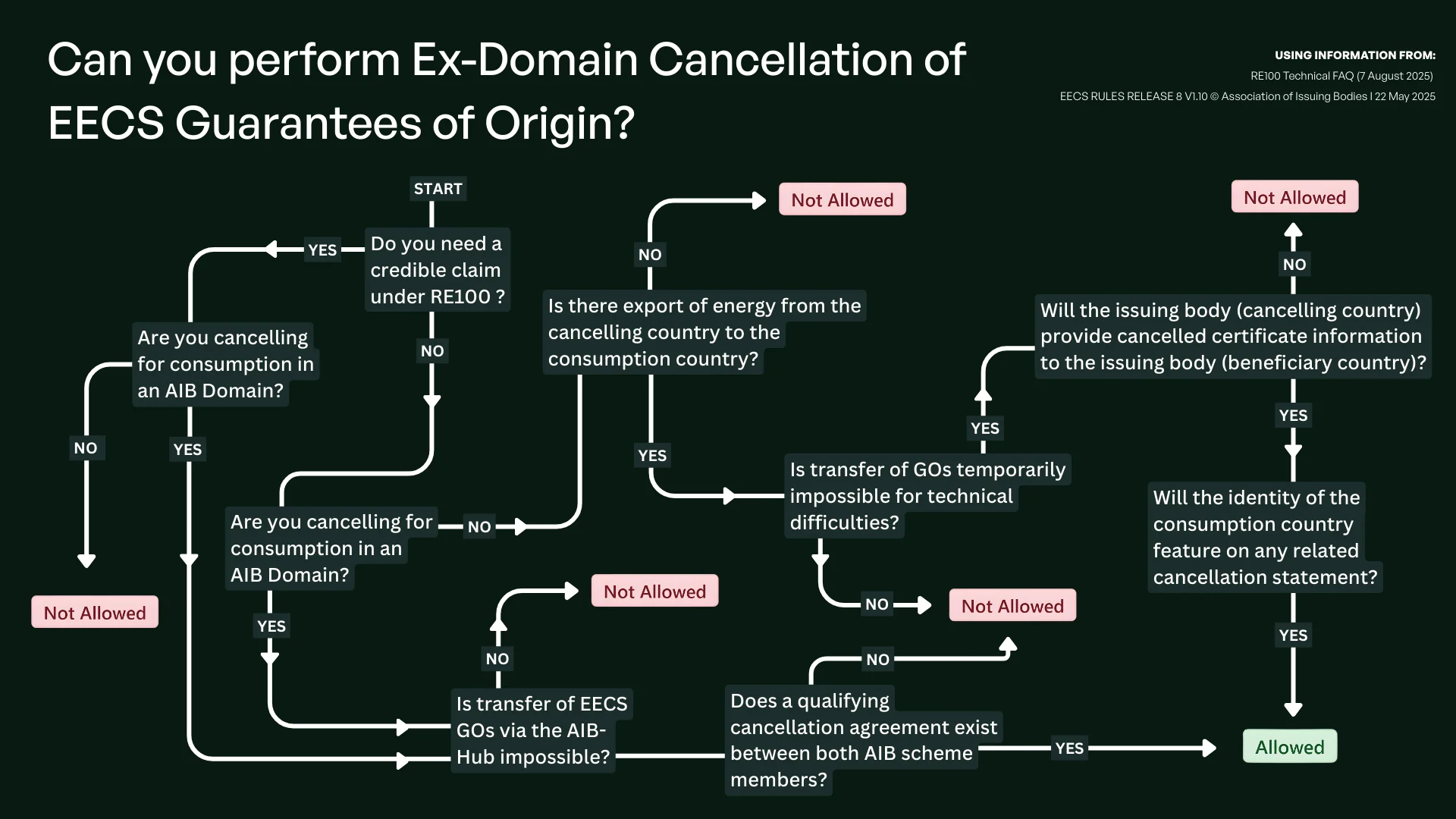
Here's a full flowchart that shows this process in detail.
Ex Domain Cancellations - Validity Flowchart
RE100:
RE100
takes the same position in their 2025 Technical FAQ: claims that skip this registry transfer
aren't recognised
. That means a certificate cancelled in Finland can't support a claim against German consumption -
“
it does not observe the RE100 market boundary definition
”. That’s a highly important detail that, if missed, will be troublesome from a watertight
reporting perspective.
Auditors sometimes miss this fact, presumably due to the very apparent interoperability of the
system overall, assuming that cancellation can replace a transfer, and the end-result is the same.
They mistakenly treat cancellation as a yes/no event rather than explicitly checking which
registry was used.
The pattern is very clear: most countries that allow it treat it as a
fallback for when Hub transfer isn't possible - the "technical difficulties" clause
(C7.1.1(c)(ii))., not as a routine or best-practice mechanism.
Country
Status
Conditions / Notes
Known Destinations
Allowed (unconditionally or broadly)
Luxembourg(outbound)
Interestingly, cancellation from Luxembourg for use in another domain is
straightforwardly allowed with no conditions. Inbound is a different story: only
permissible when transfer into the ILR registry isn't technically possible.
Export-only domain with no end-consumers (offshore only). Ex-domain cancellation is
only performed when transfer to the destination Scheme Member is not technically
possible and a cancellation agreement is in place. In such cases, CREG performs
cancellations manually.
—
Lithuania
Permitted where transfer is not possible, under a Cancellation Agreement with the
other Domain's Scheme Member. In practice this has happened only once, suggesting the
bar is rarely met.
Latvia (2016, once)
Switzerland
Permitted where Hub transfer is technically impossible, provided there's an agreement
between Pronovo and the importing Issuing Body. In practice, limited to AIB members
without a Hub connection.
AIB members without Hub connection only
Belgium Brussels
Requires a formal bilateral agreement between BRUGEL and the relevant Competent
Authority. None currently in place.
—
Belgium Wallonia
Only with established agreements, though informal arrangements exist with VREG
(Flanders) and BRUGEL (Brussels) for non-EECS GOs due to sub-national fragmentation.
—
Belgium Flanders
Exists as an emergency fallback only. Electronic transfer must be technically
impossible and there must be urgency towards a legal deadline.
—
Croatia
Restricted to cases where Hub transfer is impossible. HROTE approval and a bilateral
agreement are both required, and Hub-reachable domains are explicitly excluded.
—
Cyprus
Only where Hub transfer is technically impossible, with approval needed from both TSO
Cyprus and CERA plus a bilateral agreement with the other Scheme Member.
—
Czechia
Limited to non-AIB member countries under exceptional circumstances confirmed by state
stakeholders.
—
Denmark
Restricted to non-AIB countries within the EU. Energinet must approve in advance, and
the destination country and specific beneficiary must be stated, leaving little room
for ambiguity.
UK, Slovakia, Spain
Finland
Available for countries not connected to the AIB Hub. Hub-connected countries must use
transfer and local cancellation instead.
Non-AIB countries (unspecified)
France
Restricted to European countries whose registries lack Hub access. These cancellations
feed into the French residual mix calculation.
UK (primary), Poland, Hungary, Romania
Greece
Exceptional cases only, with a bilateral agreement required. Direct ex-domain
cancellation in favour of a Greek end consumer is explicitly not allowed.
—
Hungary
Requires both considerable market interest and a bilateral agreement between MEKH and
the beneficiary country's competent authority.
—
Ireland
Permitted where electronic transfer is technically impossible, with agreement of the
importing issuing body.
UK
Latvia
The Domain Protocol (2026) says allowed with conditions, but the Disclosure Datasheet
(2025) says "No."
—
Norway
Open to non-AIB countries on request, which is relatively permissive. For AIB members,
only when Hub transfer is impossible. By far the most active ex-domain canceller in
the AIB network.
40+ countries including Albania, Andorra, Argentina, Australia, Azerbaijan, Belarus,
Bosnia and Herzegovina, Brazil, Bulgaria, Canada, Chile, Faroe Islands, Gibraltar,
Greece, Hungary, India, Israel, Japan, Kazakhstan, South Korea, Latvia, Liechtenstein,
Malta, Moldova, Monaco, Montenegro, New Zealand, North Macedonia, Peru, Poland,
Portugal, Romania, Russia, Serbia, Singapore, Slovakia, Turkey, Ukraine, UK, USA
Portugal
Limited to specific cases (non-AIB members, remedial actions). Acceptance is
guaranteed for the Autonomous Regions of Madeira and Azores.
—
Serbia
Legally possible under the framework, but no bilateral EDC agreements currently exist
in practice.
—
Slovakia
Restricted to non-EECS countries. EECS domains must go through Hub transfer first.
—
Slovenia
Allowed under specific conditions.
—
Sweden
Prohibited for EECS countries. GOs must be transferred via the Hub to the destination
registry for local cancellation.
Non-EECS countries
Not Allowed
Austria
General prohibition, with one narrow exception for AIB members whose Hub connection is
not yet established and a bilateral cancellation agreement is in place. Historically
some ex-domain cancellations did occur, but none in recent years.
—
Estonia
Explicitly prohibited in both directions. Cannot cancel in Estonia for another domain,
nor cancel elsewhere for use in Estonia. Historical cancellations did take place, but
no longer permitted.
—
Germany
Explicitly prohibited. Any GOs imported into Germany must be cancelled for German
consumption.
—
Iceland
The framework structurally supports it, but Landsnet has no bilateral agreements in
force with any country. Effectively prohibited in practice.
—
Italy
Not allowed.
—
Netherlands
Not allowed. GOs cannot be cancelled in the Netherlands for consumption in another
country.
—
Spain
Not allowed. Spain stopped ex-domain cancellations entirely in January 2020.
—
How Do Companies Manage GO Cancellations Across Multiple EAC Registries?
Cross-border renewable procurement and cancellation means dealing with transfer mechanics across
30-plus national registries, each running their own export and cancellation procedures. On top of
this, you’re dealing with private standards like
RE100
that explicitly prohibit Ex-Domain cancellation. It’s a lot to manually balance, leading to
intense periods of administrative busywork.
A multinational with consumption in Germany, Sweden, and the Netherlands ultimately needs to have
their certificates cancelled in three separate registries, properly transferred and documented
before each cancellation event. Working through intermediaries who don't have direct registry
access introduces delays and documentation gaps. You need a platform that integrates with every
registry and allows you to download the source documentation: the
export-ready cancellation statements
- these are the only documents that actually proves compliant consumption.
Soldera
integrates directly into registries across Europe from a single account, running export, transfer,
and cancellation as one automatically-compliant workflow. The
platform
is designed for corporates that require verified cancellation statements across any
multi-jurisdiction portfolio - build a compliance position that holds up.
You're halfway there...
Sign up free to keep reading immediately and get Soldera's EAC market research, price updates, quarterly outlooks and renewable compliance insights direct to your inbox.
Oliver Bonallack is Growth Marketing Lead at Soldera. His writings focus on Energy Attribute Certificates (EACs) and Guarantees of Origin (GOs). He has a background in venture analysis and public policy, with a First Class BSc in Politics & International Relations from the University of Bristol alongside top performance in the Venture Institute and the Terra.do Climate Fellowship. His climate and energy experience includes building AI-first workflows for registry operations and investing in climate technology startups via Collective VC and Team Ignite Ventures. His day-to-day work focuses on compliance and registry ops, market data and policy research, content and GTM systems, and automation across renewable certificate processes
Stop managing registries, start meeting targets. Schedule a 20-minute demo to find out if Soldera is right for you.